












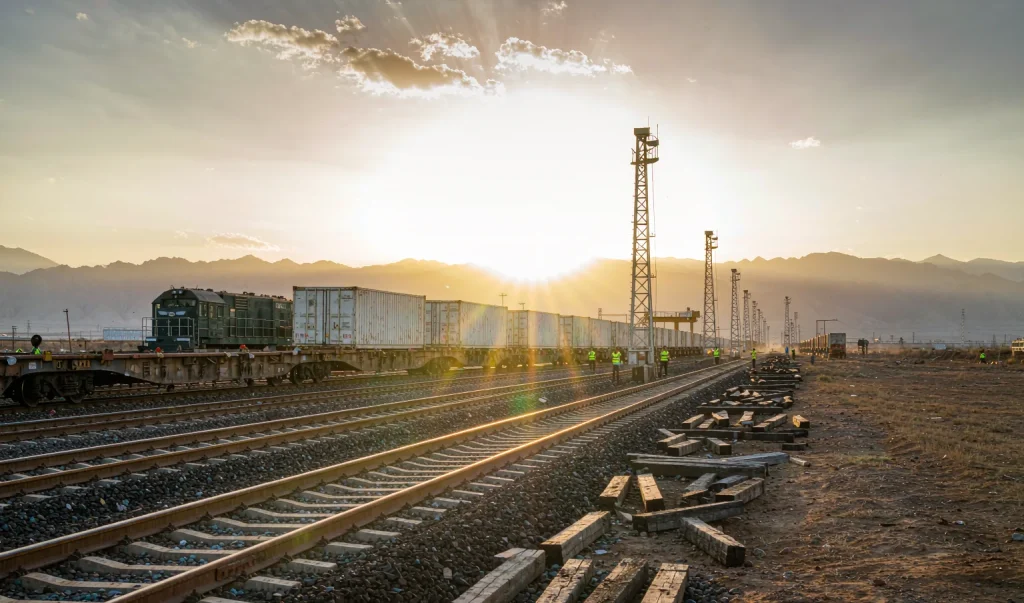
China’s two western rail gateways quietly reset their own capacity limits in early November, and the details matter more than the headline numbers. By 3 November, Alashankou and Khorgos had passed 15,775 China-Europe and China-Central Asia trains this year, carrying 32.07 million tonnes. Khorgos crossed the 8,000-train mark on 3 November with a departure toward Lodz; Alashankou passed 7,000 trains on 12 November, 45 days earlier than last year. Behind those figures sits a change that affects what a shipper can actually book: maximum train formation rose from 50 wagons to 55, payload from 2,500 to 3,000 tonnes, and border clearance at Khorgos for import cargo was compressed from two or three days to under 16 hours.
The Numbers, Stated Precisely
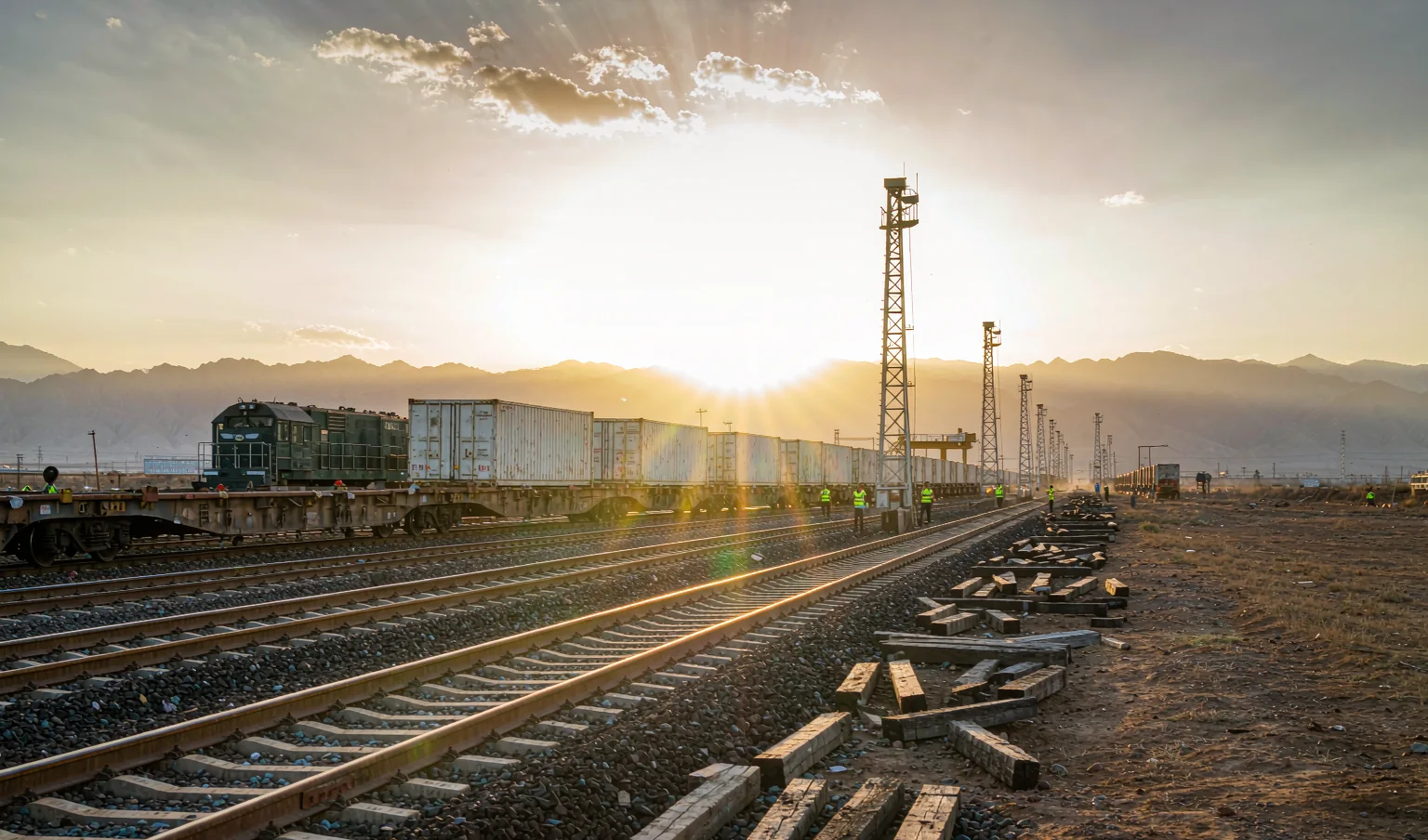
- Khorgos: 8,000 China-Europe and Central Asia trains by 3 November 2026, on 91 routes reaching 18 countries and 46 cities, carrying more than 200 categories of goods. Its road crossing handled 494,000 vehicles in January-August, up 23.3 percent, making it China’s largest land border crossing for commercial vehicles.
- Alashankou: 7,000 trains by 12 November, 45 days ahead of the 2025 date, on 130 routes serving 21 countries.
- Combined: 15,775 trains and 32.074 million tonnes as of 3 November.
- Formation: 50 to 55 wagons, 2,500 to 3,000 tonnes payload – about a 10 percent lift in channel throughput, or 10 extra trains for every 100 dispatched.
- Clearance: import dwell at Khorgos down from two to three days to under 16 hours, local export operations from six hours to one, and export steps at the Khorgos road port cut from 12 to four under a 7×24 local direct clearance model.
- Erenhot: over 4,000 trains on the central corridor by 3 November, the threshold passed by a train carrying vehicle parts and consumer goods toward Europe.
Where the Extra 10 Percent Comes From
Two operational changes delivered the gain, and both change what a forwarder can promise.
Longer formations. Fifty wagons was the practical ceiling for years because of loop length, traction and border-yard geometry. Xinjiang railway authorities reworked the whole chain – departure yard, border station, receiving tracks – and lifted the limit to 55 wagons at 3,000 tonnes. On a fixed number of train paths, that is a straight capacity increase with no new track.
Loaded return running in broad gauge. Historically many westbound trains ran out loaded and came back empty, leaving broad-gauge wagons idle on the Kazakh side. The new model – wide-gauge out loaded, standard-gauge in loaded – fills those returning wagons with import cargo instead of air. It raises two-way volume on the same infrastructure and improves equipment balance at the border, which is often the real constraint on booking a slot.
A third, quieter change is consolidation inside the terminal: containers for the same corridor are stacked and dispatched together, which shortens in-yard transfer and makes it easier to assemble a full 55-wagon block from several customers’ cargo.
Clearance in Hours, Not Days
The paperwork side moved almost as far as the steel. Under the railway express clearance model and the 95306 digital port system, manifest, arrival, release and loading data now pass between customs and railway systems electronically instead of being carried between windows on paper. At Khorgos that produced an import dwell time under 16 hours and a one-hour local export operation; port officials describe the shift as data waiting for the train rather than the train waiting for documents.
At Alashankou the same direction shows up in harder numbers. Customs reports average per-train inspection efficiency up about 70 percent under combined smart-port and local fast-clearance reforms, with non-intrusive scanning cutting a train inspection to as little as ten minutes. A joint supervision model – safety checks at the port, detailed inspection at the consignee’s site – is credited with halving overall clearance time, and one forwarding company quoted a 30 percent reduction in operating cost since it arrived.
The consequence for shippers is direct: documentation quality now shows up in transit time faster than it used to. When data arrives before the train, a clean declaration clears in hours. A wrong HS code or a weight mismatch removes your wagon from a tightly sequenced yard and pushes it into manual review.
What This Does Not Fix
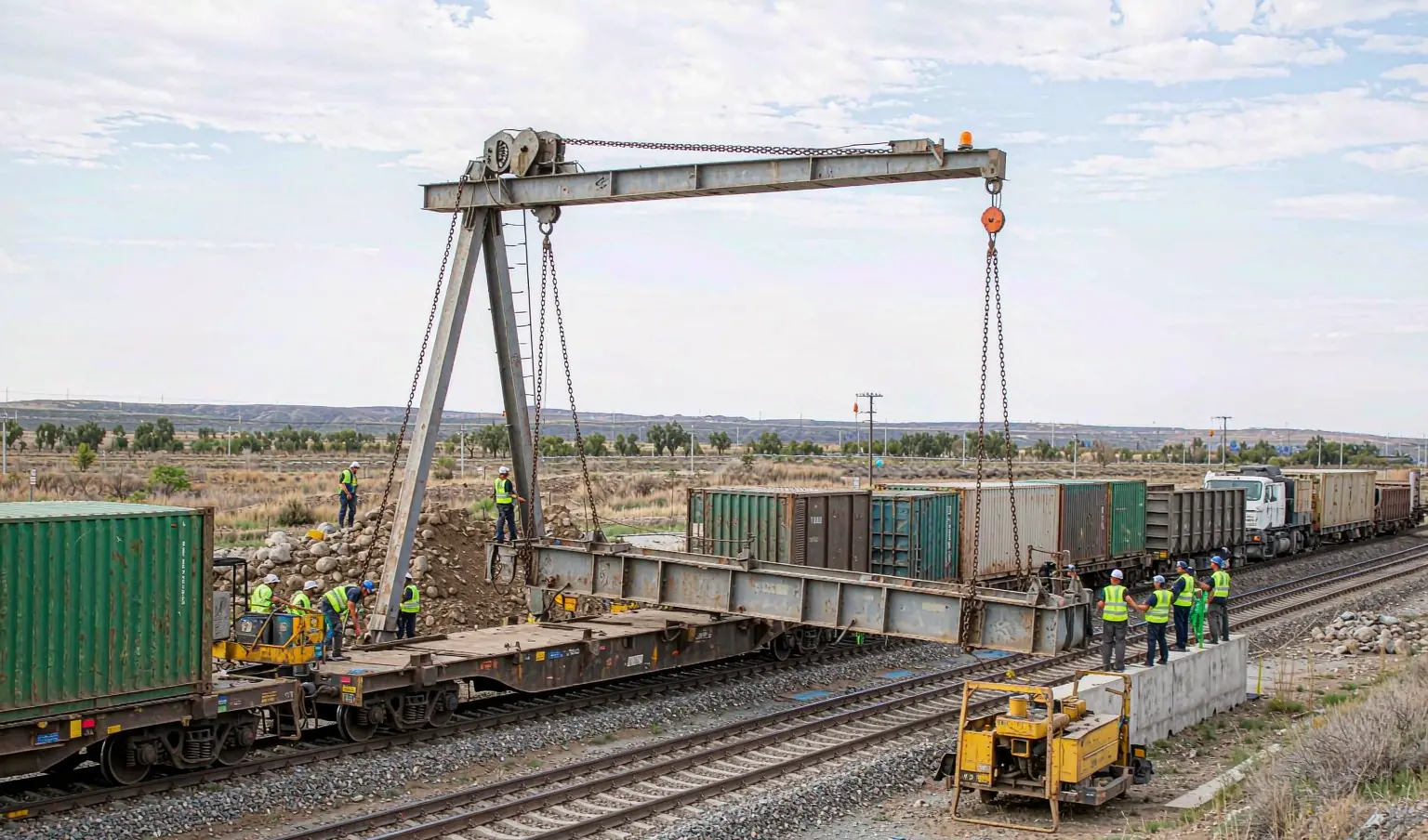
- Gauge transfer is still the physical bottleneck. Every container crossing onto the 1,520 mm network is lifted at Dostyk-Altynkol or Alashankou. Longer trains push more boxes through the same hourly transfer capacity, but they do not remove the lift.
- A slot is not a guarantee. Ten percent more capacity per train does not mean ten percent more space for your booking in the last week before Lunar New Year.
- Weather still stops trains. Alashankou’s wind corridor closes movements when gusts exceed safety limits, and Xinjiang winters add their own delays.
- The third crossing is still a 2027 story. The Bakhty-Ayagoz line will add a third gateway and about 20 million tonnes of design capacity, but today the two existing crossings remain the only rail options.
How to Use the Extra Capacity
- Book two to three weeks ahead. Pre-arrival documentation and an early slot are the difference between a 16-hour clearance and a week in a yard.
- Aim for full blocks. With 55-wagon formations, forwarders who consolidate several shippers into one block get better economics than part-loads waiting to be assembled.
- Send clean data early. The digital clearance chain assumes manifest, weights and HS codes are right before arrival. Fix discrepancies at origin, not at the border.
- Use TIR where speed wins. For urgent full truckloads into Kazakhstan or Uzbekistan, road is faster, and eTIR has cut paperwork at the same borders.
- Plan the pre-holiday window now. Factory closures around Lunar New Year create a demand spike no corridor efficiency absorbs.
- Ask which gateway and which formation. Two bookings with the same transit estimate can sit on different crossings with very different queue positions.
Why the West Corridor Keeps Winning
Alashankou and Khorgos move the overwhelming majority of China-Europe rail cargo, and the 2026 numbers explain why carriers keep investing there: 130 routes from one port, 91 from the other, 21 and 18 destination countries respectively, and a clearance system that runs on data rather than paper. Add loaded return running, and the corridor has addressed both of its historic weaknesses – empty backhaul and slow border handling – in the same year. For importers into Central Asia that means more reliable weekly departures and shorter dwell; for importers into Europe it is a reminder that the land bridge is a set of competing gateways, and choosing one is a supply-chain decision rather than an administrative one.
How CargoSolid Helps
CargoSolid books rail and TIR capacity from China to Kazakhstan, Uzbekistan, Turkmenistan, Kyrgyzstan and onward into Russia and Europe through the western gateways, with land and rail freight services and door-to-door DDP options that put customs, duty and final delivery under one fixed price. We follow gateway queues and formation changes week by week, and we tell you which crossing and which mode fits your deadline rather than quoting the cheapest headline rate. Send us your cargo details and delivery dates for a routing comparison. Contact cargosolid@outlook.com or WhatsApp +86 186 7539 5280.
Frequently Asked Questions
How many trains passed through Alashankou and Khorgos in 2026?
By 3 November 2026 the two ports had handled 15,775 China-Europe and China-Central Asia trains carrying 32.074 million tonnes. Khorgos passed 8,000 trains on 3 November and Alashankou passed 7,000 on 12 November, 45 days earlier than in 2025.
What changed about train length on the China-Europe corridor?
Maximum formation rose from 50 to 55 wagons and payload from 2,500 to 3,000 tonnes, roughly a 10 percent throughput gain per train path – the equivalent of 10 extra trains for every 100 dispatched, without new track.
How long does customs clearance take at Khorgos now?
Import cargo dwell has been cut from two to three days to under 16 hours, and local export operations from six hours to one, using the railway express clearance model and the 95306 digital port system. Documents must be accurate and submitted before arrival to benefit.
Does the extra capacity mean I get a rail slot more easily?
It helps but it is not a guarantee. Ten percent more capacity per train does not remove peak-season demand around Lunar New Year, weather closures on the Alashankou wind corridor, or the gauge-transfer bottleneck where containers are lifted between standard and broad gauge.
Are there other rail gateways besides Alashankou and Khorgos?
For China-Europe and Central Asia cargo these two remain the western corridor gateways. A third China-Kazakhstan crossing, the Bakhty-Ayagoz line, is under construction and due to open in 2027 with about 20 million tonnes of design capacity. Erenhot handles the central corridor.
Should I use rail or TIR trucking to Central Asia?
Rail is the volume workhorse for containers and steady flows, typically around 20 to 28 days door-to-door to Kazakhstan and Uzbekistan. TIR is faster at roughly 14 to 20 days and better for urgent loads and door delivery. Many shippers split volume between the two.
Related Materials
- Kazakhstan’s Third Rail Crossing to China Nears Completion
- China-Europe Rail in October 2026: Border Queues and Faster Corridors
- Erenhot Passes 26,000 China-Europe Trains: The Numbers Explained
- Shipping from China to Kazakhstan 2026: Rail, Truck & Air Freight Guide
- Shipping from China to Kazakhstan | Uzbekistan | Land & Rail Freight Services
- DDP Shipping from China | FAQ | Contact Us
Get in Touch
Tell us what you are shipping and where it is headed. Our team usually replies within one business day with a tailored quote.