












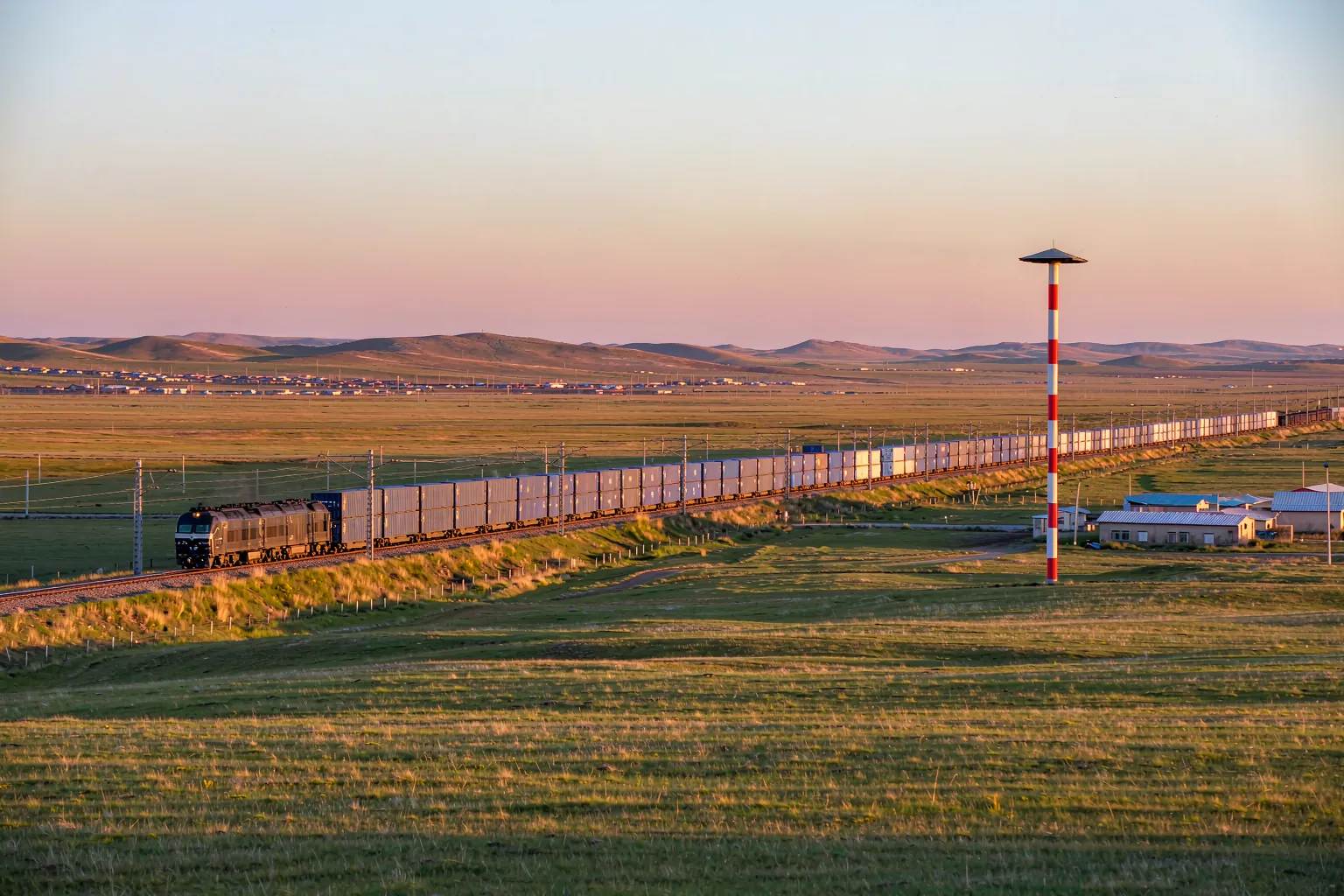
On 24 August, the Erenhot rail port on the China–Mongolia border passed 26,000 cumulative China–Europe freight trains since the first one in 2013. Erenhot is the only crossing on the so-called middle channel, the route that runs north from China through Mongolia and into Russia. Milestone announcements come and go, but the numbers behind this one say a lot about where Eurasian rail freight is heading.
1. A Growth Curve That Keeps Steepening
The cumulative total tells the story better than any speech. It took five years to clock the first 1,000 trains. The latest 1,000 took under three months.
| Year (cumulative) | Total trains via Erenhot |
|---|---|
| 2018 | 1,000 |
| 2020 | 5,000 |
| 2022 | 10,000 |
| 2025 | 20,000 |
| August 2026 | 26,000 |
This year alone, through 24 August, the port handled 3,157 trains carrying 3.0038 million tonnes of cargo — up 10.2% and 27.0% respectively year on year. The tonnage growing nearly three times faster than train count is the interesting part: loads are getting heavier and fuller, not just more frequent.
2. What Runs Through Erenhot Today
- Frequency: roughly 13 China–Europe trains per day, stable through 2026.
- Network: 76 routes reaching more than 70 hub stations across Germany, Poland and 10-plus other countries.
- Coverage: trains departing from most major Chinese origin cities can transit here.
- Clearance: the 95306 digital port system links rail, customs and border inspection data; clearance at the port has been compressed to as little as around 30 minutes for scheduled trains.
3. The Cargo Mix Shift Is the Real Headline
Early trains out of Erenhot carried mostly metals, chemicals, garments and shoes — bulky, low-value goods filling cheap capacity. That has reversed. New energy vehicles, electronics and household appliances now dominate, and high-value “Made in China” goods have risen from under 10% of the cargo mix in the early years to more than 40%. When a corridor starts carrying cars and consumer electronics instead of ore, it has stopped being a subsidy experiment and become working infrastructure for brand owners.
We see the same shift in our own bookings: shippers moving EVs, e-commerce stock and appliances choose rail for the schedule certainty, not the price. If you want the detail on how the rail options compare, the land & rail freight service overview is a good starting point.
4. Erenhot vs the Western Crossings
Erenhot is not the only game in town. The same week, Khorgos on the China–Kazakhstan border reported more than 6,000 China–Europe and China–Central Asia trains this year with over 10 million tonnes of cargo, on 91 routes reaching 18 countries and regions; combined with Alashankou, the two Xinjiang crossings have passed 11,000 trains, up 5.9%. Different crossings serve different needs:
| Routing | Via | Best suited for |
|---|---|---|
| Middle channel (north) | Erenhot → Mongolia → Russia | Russia, Belarus, northern Europe; shortest distance from north China origins |
| Western channel (south) | Khorgos / Alashankou → Kazakhstan | Central Asia, Caspian corridor, Caucasus, Turkey, southern Europe |
| Western channel (alt) | Alashankou → Kazakhstan → Russia | Russia and Europe with flexible Kazakh transit |
The practical rule we use: cargo to Russia and Belarus generally moves fastest via the middle channel from northern Chinese origins; cargo to Kazakhstan, Uzbekistan, Azerbaijan and beyond goes west through Xinjiang. When gauge-change congestion builds at one crossing, the other buys you optionality — one reason we monitor dwell times at both.
5. Border Efficiency, in One Paragraph
The “two stations, one system” model pairs Erenhot with its Mongolian counterpart Zamyn-Üüd on daily calls and monthly meetings, sharing train and yard data. Combined with the green-channel handling for scheduled trains and the 95306 digital port, a scheduled China–Europe train no longer loses a day at the border. On a route where the whole pitch is 12–18 days door to door, that efficiency is the difference between rail and sea.
For destination-side detail, our China to Russia freight guide covers rail, sea and air options with transit times, and the Kaliningrad enclave has its own routing quirks worth a separate look if you ship there.
Related Reading
- China to Russia Freight Guide: Rail, Sea & Air
- Land & Rail Freight Services
- Shipping from China to Kazakhstan — Country Guide
- Shipping From China — Route Hub
Request a Quote
Tell us your cargo type, volume and destination. Our freight team replies with a routing plan and a firm transit quote.