










The Trans-Caspian route — the Middle Corridor that runs China → Kazakhstan → Caspian ferry → Azerbaijan → Georgia → Turkey/Europe — has spent the summer quietly graduating from PowerPoint to concrete. Three things happened in quick succession: the Baku–Tbilisi–Kars railway completed its upgrade, Azerbaijan and Georgia agreed to halve freight border procedures, and the EU lined up around €2 billion for regional transport links. Here is what is actually done, what is promised, and what it means for your routing decisions.
1. BTK Is Finally Running at Full Tilt
The Baku–Tbilisi–Kars railway entered full commercial operation on 2 June 2026, after modernisation of the 180 km Marabda–Kartsakhi section in Georgia and completion of a European-standard bogie-changing terminal. Annual capacity now stands at 5 million tonnes. For context, this railway was opened in 2017 with big promises and then spent years handling a fraction of them. The upgrade matters because BTK is the rail bridge from the Caspian shore to Turkey — the segment every east–west load must cross after the ferry.
The road side feels it too: Georgia’s transport corridor has handled 9,200 more trucks year to date than in the same period of 2025.
2. Border Clearance Between Azerbaijan and Georgia, Halved
On 3 August, railway and customs officials from Azerbaijan and Georgia signed an operational accord at the Boyuk-Kesik frontier station that cuts freight-train border procedures by half. The details are refreshingly practical: duplicated wagon technical inspections across the two border stations are scrapped, inspections are one-sided per direction of travel, Azerbaijani electric locomotives may now run the full Boyuk-Kesik–Tbilisi section instead of splitting trains at the boundary, and real-time digital cargo data sharing between the two countries’ railway and customs systems will roll out in the coming months.
Anyone who has tracked a container sitting at a Caucasus border station for a day and a half will understand why this is the single highest-leverage change on the list.
3. The Money Is Arriving
- EU platform: launched in August 2026 to link Europe with Central Asia via the Black Sea and South Caucasus, mobilising roughly €2 billion alongside international financial institutions.
- €2 billion, with caveats: EU officials project Trans-Caspian cargo could grow fivefold over 15 years. Treat that as an ambition, not a forecast — corridor projections have historically outrun delivery.
- Kazakhstan spending: about half of a projected $10 billion infrastructure budget through 2030 is deployed, including new rail lines and a 270-locomotive order from China; a $462 million package with European partners was announced in August.
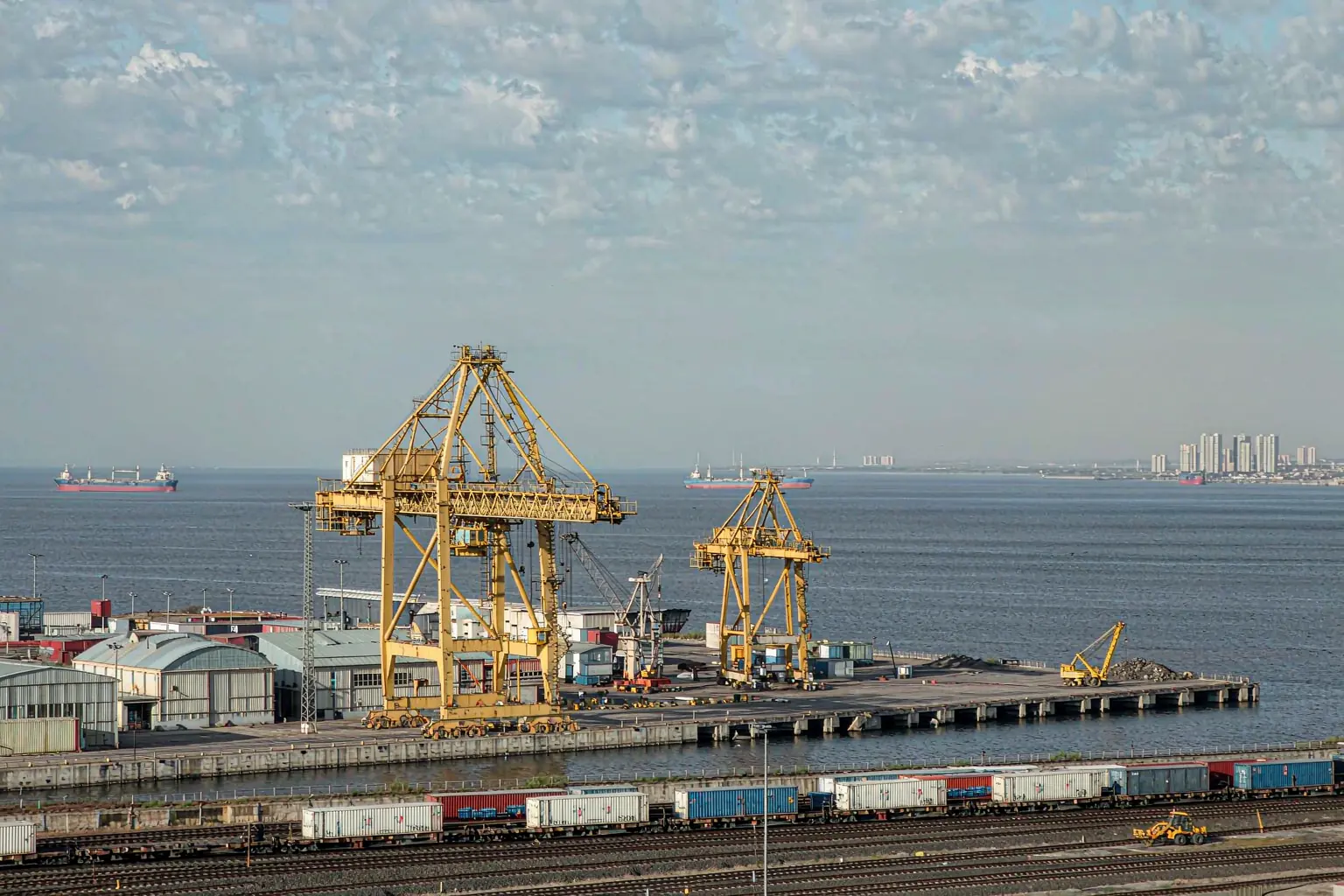
- Port capacity: dredging at Kuryk is complete, Aktau is getting two dedicated container berths expected to double handling capacity, and a 120,000 TEU terminal at Poti is already operating.
4. The Volumes Behind the Headlines
Kazakhstan’s Ministry of Transport puts Middle Corridor freight at over 4.5 million tonnes annually, up more than fivefold in seven years from 0.8 million. Container traffic reached about 77,000 TEU in 2025, with an official target of 300,000 TEU by 2029. In the first quarter of 2026, 125 container trains transited the route, up 34.4% year on year, and the Xi’an–Alat service alone ran 85 trains — double last year. Kazakh officials say transit times have nearly halved, from 28–32 days to 11–13 days, and that cargo origins have widened beyond Xi’an to Zhengzhou, Yiwu, Hefei, Wuhan, Tianjin, Shenzhen and Guangzhou.
On the Caspian itself, Kazmortransflot carried a record 7,451 TEU between Aktau and Azerbaijan in May 2026. That is the good news. The caveat: Caspian ferry and port capacity remains the binding constraint, and falling water levels at some ports restrict how fully vessels load. Domestic Kazakhstan upgrades like the 323 km Moyynty–Kyzylzhar line, due to complete by end-2026, take 149 km off the route and lift section capacity from 14 to 28 freight trains per day — but the Caspian crossing, not Kazakh track, is where the queue forms.
| Option | Transit time (China→Europe/Caucasus) | Sweet spot |
|---|---|---|
| Middle Corridor | 11–18 days depending on ports and ferry slots | Caucasus, Turkey, Central Asia; Russia-avoidance; schedule certainty |
| Northern rail (via Russia) | 12–18 days | Cheapest land option where Russia transit is acceptable |
| Sea (Suez) | 35–45 days | Cost-driven volumes, full containers |
5. Who Should Route This Way Now
Our rule of thumb after quoting this corridor all year: use the Middle Corridor when your destination is Azerbaijan, Georgia, Armenia or Turkey; when your buyer requires avoiding Russian transit; or when you need a land-freight schedule and northern rail slots are tight. Keep sea as your baseline for cost, and remember the corridor’s remaining weak link is ferry capacity — book Caspian crossings with a forwarder who holds allocations, not on the spot.
For country-specific routing and transit-time detail, see our guides for Kazakhstan, Azerbaijan and Turkmenistan, plus the new Zhengzhou–Baku bill of lading train if your bank needs negotiable documents.
Related Reading
- Shipping from China to Kazakhstan — Country Guide
- Shipping from China to Azerbaijan — Country Guide
- Shipping from China to Turkmenistan — Country Guide
- Land & Rail Freight Services
Request a Quote
Tell us your cargo type, volume and destination. Our freight team replies with a routing plan and a firm transit quote.