












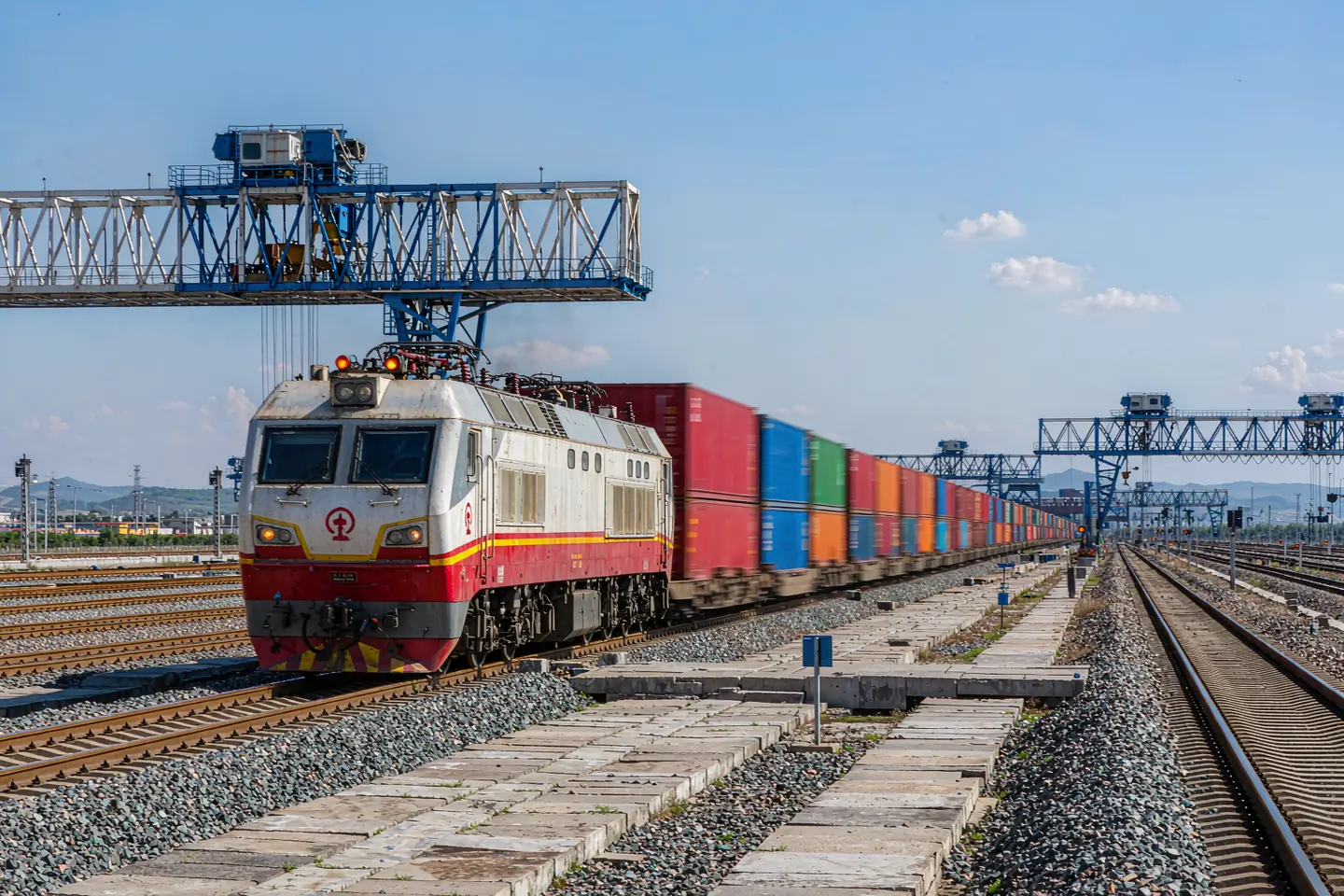
On 26 August, a train of 55 containers left Zhengzhou International Land Port carrying auto parts and household appliances bound for Baku. Plenty of China–Europe trains depart every week, so the cargo is not the story. The document is. This is the first Southern Corridor China–Europe train to run on a multimodal bill of lading — one document covering the whole rail-sea-rail journey, door to door.
1. The Problem a Bill of Lading Actually Solves
Cargoes on the Trans-Caspian, or Middle Corridor, cross several countries and a sea leg: rail in China and Kazakhstan, ferry across the Caspian, rail again through Azerbaijan and Georgia, then sea or road to Europe. Traditionally each segment travelled under its own rail waybill. Because formats differ country by country, forwarders re-issued documents at each handover, and the whole chain depended on the classic rail consignment note — a document that proves who shipped what, but not one banks treat well.
The awkward part is commercial rather than operational. A rail waybill is not a negotiable document of title. Under a letter of credit, banks want a document that represents the goods and can transfer ownership. When your cargo moves 7,000 km under three incompatible waybills, confirming who owns the goods at any given moment becomes slow, and financing against the cargo becomes painful. That is exactly what this first bill of lading train addresses: one document, end to end, with traceable ownership from the moment the container leaves Zhengzhou until release in Baku.
2. What Ran on 26 August
- Train: 55 container flat cars, loaded with auto parts and household appliances.
- Route: Zhengzhou westbound via Kazakhstan, Caspian ferry crossing, delivery to Baku, Azerbaijan.
- Document: a single multimodal bill of lading covering the full journey — the first issued for a Southern Corridor China–Europe train.
- Effect: one document, one liability chain, full traceability, no re-papering at each border.
The same day, the first scheduled China–Laos–Thailand express train left Zhengzhou as well, running via the Mohan border gate and across Laos to the Laem Chabang port area in five to six days. Different corridor, same idea: China’s inland hub cities are assembling scheduled, documented, multi-route products instead of one-off block trains.
3. Why This Matters More Than Another Volume Record
Volume records on Eurasian rail are announced weekly; document innovation is rarer. A usable multimodal B/L changes who can ship on the corridor. Traders paying by letter of credit — which includes most Azerbaijani, Central Asian and Middle Eastern importers dealing with new Chinese suppliers — need documents their banks accept. Until now that pushed a lot of cargo onto sea freight with its familiar ocean B/L, even when rail was faster. A negotiable multimodal document closes part of that gap.
| Item | Traditional rail waybills | Multimodal bill of lading |
|---|---|---|
| Documents per shipment | One per segment, formats differ by country | One document for the whole journey |
| Ownership / title | Not a document of title | Negotiable, transfers ownership |
| Bank financing (L/C) | Often rejected or requires extra guarantees | Accepted like an ocean B/L |
| Traceability | Fragmented across national systems | One reference, end to end |
| Re-papering at borders | Required at each handover | None |
4. Practical Notes Before You Rush to Book
One train does not make a product line. Expect the B/L option to roll out route by route, and expect the first issuances to be carefully vetted by banks before they become routine L/C collateral. If you are shipping to Azerbaijan or onward to Georgia and Turkey, ask your forwarder two questions: can they issue a multimodal B/L on your specific routing, and is your bank in their issuing network? Both answers should be yes before you build a supply chain around it.
For route fundamentals — transit times, costs and customs across the Caspian — our China to Azerbaijan country guide and China to Kazakhstan country guide cover the practical details, and the land & rail freight service page explains how we combine rail and ferry legs.
5. The Bigger Picture
The bill of lading train is one piece of a wider push on the Southern Corridor this summer: digital customs transit via eTIR across the Caspian, faster border clearance between Azerbaijan and Georgia, and heavy infrastructure spending at the Caspian ports. Documents, border procedures and port capacity are improving at the same time. That combination — not any single headline — is what slowly turns a corridor into a product.
Related Reading
- Shipping from China to Azerbaijan — Country Guide
- Shipping from China to Kazakhstan — Country Guide
- Land & Rail Freight Services
- Shipping from China to Uzbekistan | Complete Freight Guide
Request a Quote
Tell us your cargo type, volume and destination. Our freight team replies with a routing plan and a firm transit quote.