












Customs officers in Azerbaijan, Turkmenistan and Uzbekistan have quietly completed something the freight industry has discussed for years: fully paperless TIR transports crossing the Caspian Sea. Six runs in late July, drivers carrying no transit document at any border, and one procedure covering road and sea legs across three territories. If you ship by truck between China, Central Asia and the Caucasus, this is worth ten minutes of your time.
1. What Actually Happened
On 7 July 2026, Uzbek Customs processed its first eTIR operation, releasing a load of bulk materials that had arrived from Tajikistan. Until then the two countries exchanged transit data on paper. Uzbek border officers then went through a training programme run by the UNECE TIR secretariat and the IRU so the procedure would be applied the same way at every crossing point.
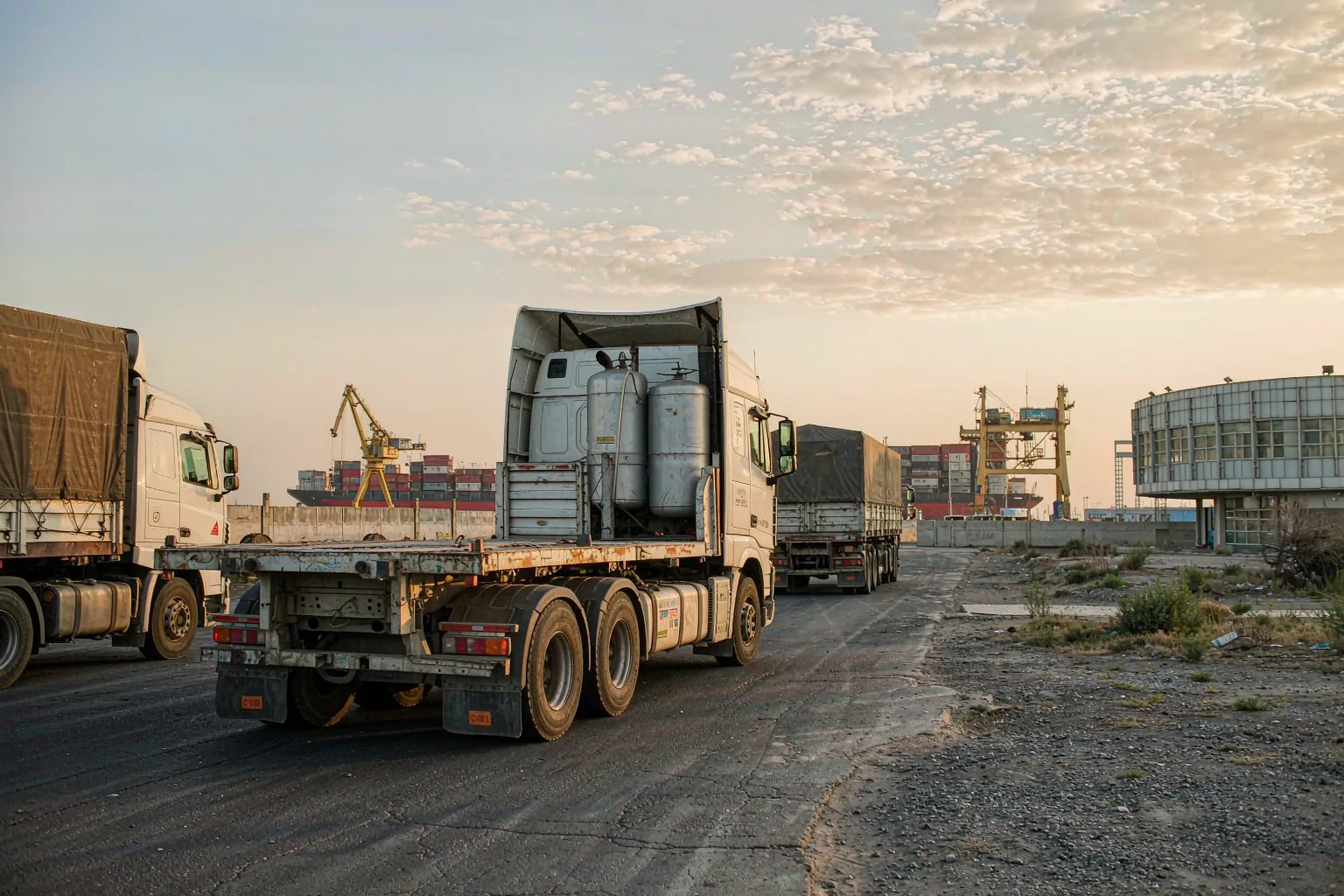
The bigger step came in the last week of July. One vehicle loaded with electronic equipment left Azerbaijan by road, crossed the Caspian by ferry to Turkmenbashi, drove the length of Turkmenistan and entered Uzbekistan at Farap — more than 1,200 km under a single procedure. In the opposite direction, four vehicles carrying cotton, fruit juice, bottled water and confectionery left Turkmenistan and ferried across to Alat, the port serving Baku. At no point did any driver hand over a paper transit document. Customs offices exchanged declarations and guarantee data in real time through the eTIR International System hosted by UNECE.
2. How eTIR Differs From Paper TIR
The TIR system itself is unchanged — it remains the only global customs transit system, based on a UN convention with more than 70 contracting parties. What changed is the plumbing. Since 2020, Annex 11 of the TIR Convention provides the legal basis for running the procedure without paper, and the eTIR International System now handles the data exchange between customs administrations, the transport operator and the guarantee chain.
One practical detail deserves attention. Uzbekistan, Turkmenistan and Tajikistan ran these operations on the eTIR National Application, an open-source tool UNECE supplies free of charge. That matters because it lets a customs administration start digital TIR operations quickly, before building a direct connection between the eTIR system and its own national customs software. Azerbaijan took the deeper route and exchanges data straight from its national system. Electronic guarantees for the July runs were issued through the international guarantee chain by the IRU member associations ABADA, THADA and ABBAT.
| Aspect | Paper TIR carnet | eTIR procedure |
|---|---|---|
| Transit document | Physical carnet, stamped at each office | Digital, exchanged in real time between customs systems |
| Border formalities | Manual handling, physical stamping | Shorter processing, fewer human errors |
| Guarantee | Voucher-based, paper trail | Electronic guarantee via the IRU chain |
| Risk control | Data available after the fact | Customs gets earlier, better data for risk targeting |
| Cost | Printing, handling, correction costs | Lower per-operation transit cost |
3. Why the Caspian Crossing Is the Right Test Bed
The Alat–Turkmenbashi ferry link is the point where Middle Corridor cargo changes customs jurisdiction mid-route. Freight between China and Europe on this corridor passes through several customs territories plus a sea leg, and every transfer used to add paperwork and processing time. Digitising the customs transit piece does not add vessel capacity, but it removes one of the friction points shippers complain about most.
Permit digitisation is moving in parallel, and it is worth understanding the difference. E-permits decide whether a carrier may operate a route and in what numbers; eTIR decides the customs status of the cargo itself. Kazakhstan and Georgia started a bilateral e-permit exchange pilot on 22 July, adding 6,000 permits for 2026 and provisionally agreeing 20,500 for 2027. Georgia runs comparable exchanges with Turkey and Azerbaijan, and agreed a full switch with Uzbekistan in the same month. Kyrgyzstan launched its own e-permit platform in January. A corridor can digitise one without the other — which is roughly the current picture.
4. What Shippers Should and Should Not Expect
Be realistic: six completed transports make this a pilot, not a rollout. Paper TIR carnets remain valid everywhere and will coexist with eTIR for years. What the Caspian runs prove is that the legal and technical chain works end to end, including across a multimodal road-sea-road route. That was genuinely uncertain before.
- Borders get faster where eTIR is live. Uzbekistan, Turkmenistan, Tajikistan and Azerbaijan are the early adopters — exactly the countries on the China–Central Asia trucking lanes we quote most often.
- Fewer document errors. No carnet means no stamp mistakes, no missing vouchers, no waiting for a corrective endorsement at a border post.
- Customs sees your data earlier. Pre-arrival risk assessment gets better, which over time means fewer physical inspections for compliant shippers.
- Do not cancel your carnet processes yet. If your route touches a country outside the pilot group, paper TIR is still the default.
For context on how fast the road-freight side of this region is changing, our Uzbekistan road transport regulations 2026 overview covers the new rules for China–Uzbekistan trucking, and the complete China–Uzbekistan freight guide explains routing options in plain terms.
5. Our Read
The Caspian was the hardest place to make TIR paperless — three customs territories, a ferry, two associations issuing guarantees. If it works here, it works on simpler bilateral lanes. We expect the next eTIR additions to come along the China–Kyrgyzstan–Uzbekistan and China–Kazakhstan corridors, where customs authorities already have the incentive and the traffic. Shippers moving e-commerce, machinery parts and perishables stand to gain first, because those are the loads where a day lost at a border post hurts most.
Related Reading
- Uzbekistan New Road Transport Regulations 2026: 4 Important Rules for China–Uzbekistan Trucking
- Shipping from China to Uzbekistan | Complete Freight Guide
- Shipping from China to Uzbekistan — Country Guide
- Shipping from China to Turkmenistan — Country Guide
Request a Quote
Tell us your cargo type, volume and destination. Our freight team replies with a routing plan and a firm transit quote.